One Limp Leads to Another: The Hidden Link Between Your Horse's Stifle and Your Dog's Sore Leg
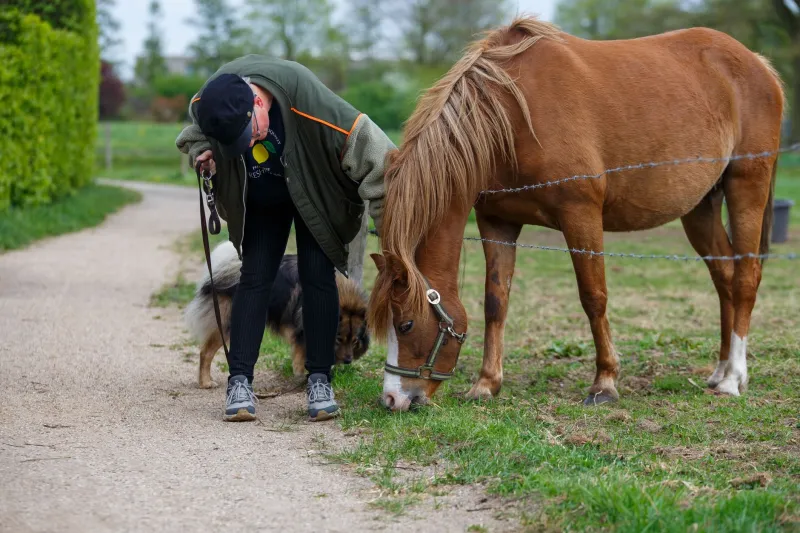
You've noticed your border collie favoring her right rear leg for a few weeks now. She's not crying out, she's eating fine, and the vet found nothing dramatic on the first pass. Meanwhile, your quarter horse has been a little resistant at the trot, swapping leads awkwardly, and occasionally dragging a hind toe in the arena. You've been meaning to call the farrier about it.
Here's a question worth sitting with: What if these two problems aren't separate at all?
It sounds like a stretch, but there's a growing body of observational evidence — and some genuinely interesting biomechanical reasoning — suggesting that horses with unaddressed stifle issues can influence the movement patterns, stress levels, and even the physical health of the dogs living alongside them. This isn't fringe thinking. It's the kind of connection that makes a lot of sense once you start looking at how animals share space, routines, and physical cues on a daily basis.
What the Stifle Actually Does — and Why It Goes Wrong
The stifle is the horse's equivalent of a human knee. It's the largest joint in the horse's body, a complex hinge connecting the femur, tibia, and patella, and it's under enormous load every time a horse moves, turns, or carries a rider. When the stifle is compromised — whether from a locking patella, osteochondrosis, soft tissue injury, or early arthritis — the horse doesn't just hurt in that one spot. The whole rear-end movement chain compensates.
A horse with a sore or weak stifle will often shift weight forward, alter its stride length, drop a hip asymmetrically, or develop secondary soreness in the hocks and lower back. It's a cascade. And because horses are masters at hiding discomfort (it's a prey animal thing), owners frequently don't catch stifle trouble until it's been quietly building for months.
The subtle signs — reluctance to go downhill, difficulty holding a collected canter, that occasional hind toe drag — are easy to dismiss as laziness or saddle fit issues. By the time the lameness is obvious, the compensation patterns are well established.
How Your Dog Gets Pulled Into the Picture
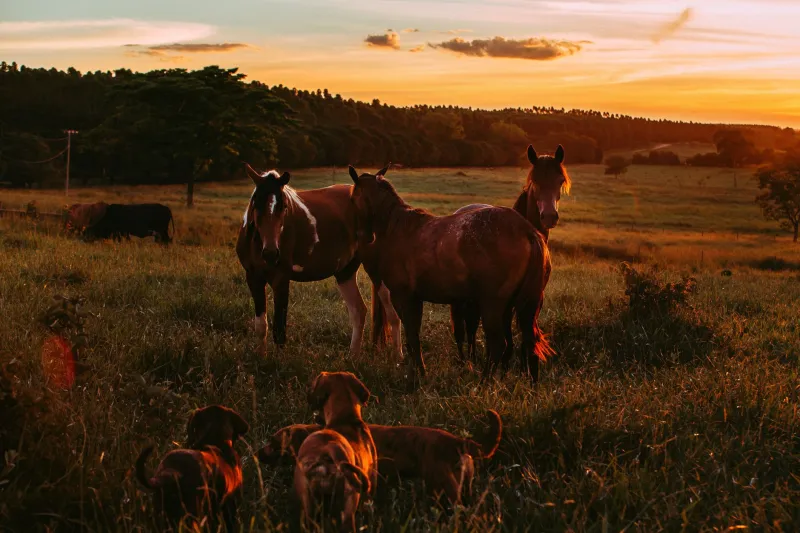
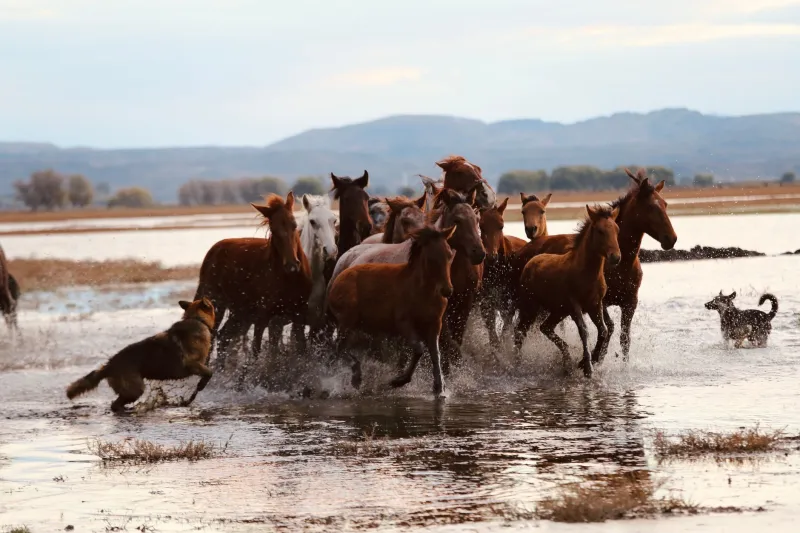
This is where it gets interesting. Dogs on working properties don't just coexist with horses — they mirror them. A stock dog or barn dog follows the horse's movement patterns throughout the day. They match pace on trail rides, they circle the paddock during turnout, and they often mimic the general energy and behavioral rhythm of the horses they spend the most time around.
Behavioral mimicry in multi-species environments is well documented. Dogs are particularly tuned to movement cues from animals they consider part of their social group, and horses often qualify. When a horse moves asymmetrically — favoring one side, shortening stride on the right — a dog that regularly moves alongside it may begin to unconsciously match that pattern. Over weeks and months, that unnatural gait pattern can create real physical stress on the dog's joints, particularly in the rear limbs.
Beyond mimicry, there's the shared environment factor. A horse in discomfort is a stressed horse. Cortisol levels rise, behavior changes, and that tension radiates through the barn. Dogs are exquisitely sensitive to stress signals from the animals around them. Chronic low-grade stress in a dog — even stress borrowed from a horse — contributes to inflammation, which can make existing joint vulnerabilities worse or cause new ones to surface.
And then there's something as simple as posture during grazing observation. Dogs that spend time watching horses at pasture often adopt extended, weight-shifted stances that, repeated daily over a long period, can load certain joints unevenly.
Catching the Connection Early
None of this means your dog's limp is definitely your horse's fault. But it does mean that if you have both animals showing rear-end issues around the same time, it's worth approaching the problem as potentially linked rather than definitely separate.
Watch them move together. Take a video of your horse moving in a straight line at the walk and trot, then do the same with your dog. Look for matching asymmetries — does the dog favor the same side the horse does? Is the stride shortening happening in corresponding limbs? A good lameness vet or veterinary chiropractor can help you interpret what you're seeing.
Get the horse properly evaluated first. Stifle issues are frequently underdiagnosed because they require a thorough lameness workup — flexion tests, nerve blocks, and often imaging. If your horse has been showing any of the subtle signs mentioned earlier, push for a complete evaluation rather than just a quick once-over. Catching a stifle problem at the compensatory stage rather than the crisis stage saves money and suffering on both ends.
Reduce shared stress. If your horse is in pain, your dog is picking up on it. Managing the horse's discomfort — whether through appropriate rest, joint support supplements, veterinary treatment, or all three — will lower the ambient stress in your barn environment and give your dog's nervous system a break.
Separate their exercise patterns temporarily. If you suspect your dog has been mimicking a lame horse's gait, changing their movement routine while the horse recovers can help break the pattern. Take the dog on separate walks with a normal-moving human rather than letting her follow the horse around the paddock.
Talk to both vets. This sounds obvious, but most people keep their equine vet and small animal vet in completely separate mental compartments. Mention to your dog's vet that the horse has been showing rear-end issues. Mention to your horse's vet that the dog has developed a limp. Giving both professionals the full picture opens up the possibility of a more integrated diagnosis.
Products That Help Both Animals
At Hoof & Hound, we stock joint support options for both horses and dogs because we know that properties running both species need solutions that work across the board. Look for omega-3 rich supplements on both sides of the fence — they address systemic inflammation whether you're dealing with a stifle or a stifle-adjacent problem in a smaller body. Quality support wraps and boots for horses with stifle instability can reduce compensatory movement, which in turn reduces the asymmetrical cues your dog is picking up on.
For dogs showing rear limb soreness, orthopedic bedding and targeted joint chews can make a meaningful difference while you work through the root cause. The goal is to support both animals through the recovery process, not just treat them one at a time.
The Takeaway
Animals that share land, routines, and emotional space share more than we often give them credit for. A horse's stifle problem doesn't stay neatly inside the horse — it leaks into the barn environment in the form of altered movement, elevated stress, and behavioral cues that the dog at its heels is quietly absorbing. Recognizing that connection doesn't just make you a more observant owner. It makes you a more effective one.
If something feels off with both animals at the same time, trust that instinct. It might be telling you something the individual vet visits aren't.