Silent Conversations: Decoding What Your Horse and Dog Are Saying to Each Other
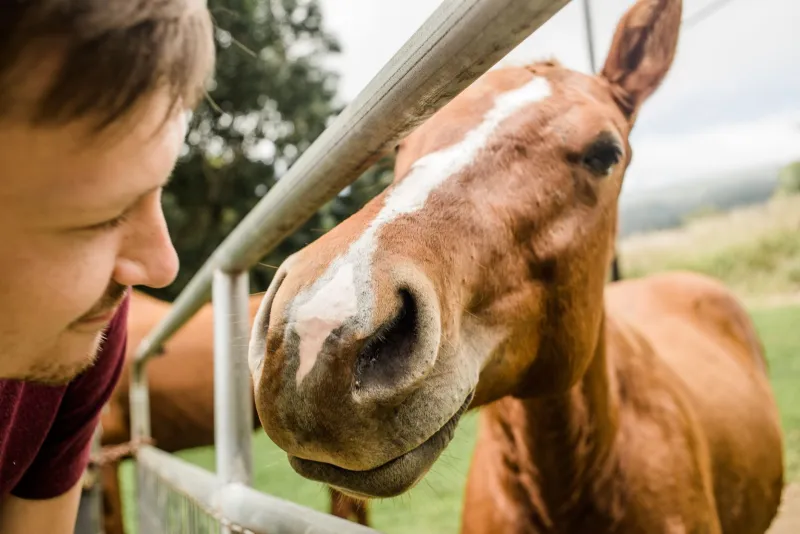
If you've ever watched your dog trot up to the paddock fence and seen your horse swing its head around with a slow, deliberate blink, you already know something wordless just happened. You just might not know what. For folks managing life with both horses and dogs — which, if you're here at Hoof & Hound, is probably a lot of you — understanding that silent exchange isn't just interesting. It's genuinely useful.
Horses and dogs are wired differently. One is a prey animal tuned to detect danger in wide-open spaces. The other is a predator built for pursuit and pack dynamics. That they coexist as peacefully as they often do is actually kind of remarkable. But peaceful coexistence doesn't mean they're ignoring each other. Far from it. They're in near-constant communication, and learning to read those signals can make your whole property run smoother.
The Nose Knows: How Scent Sets the Tone
Before any ears pin back or tails start wagging, scent is already doing the heavy lifting. Both horses and dogs have olfactory systems that dwarf ours in sensitivity. A horse can detect chemical signals — pheromones and stress markers — from other animals at distances that would seem almost impossible to us. Dogs, with their legendary noses, are picking up even more.
When a dog approaches a horse for the first time, or even after a few days apart, there's often a mutual sniff exchange that looks casual but is anything but. The horse is reading the dog's emotional state, diet, health, and stress level. The dog is doing exactly the same thing in return. That brief nose-to-nose (or nose-to-flank) moment is essentially a handshake, a background check, and a mood report all rolled into one.
If your horse suddenly seems unsettled around a dog that's been part of the property for years, don't dismiss it. Animals in pain, illness, or high stress emit different chemical signals. Your horse may be picking up on something your vet hasn't caught yet.
Ears: The Most Honest Body Part on the Property
Both species use their ears as emotional billboards, and once you start watching, you won't be able to stop.
For horses, ears pinned flat against the skull is universally bad news — anger, pain, or serious warning. Ears swiveling forward mean attention and curiosity. Ears flopped loosely to the sides? That's a relaxed, content horse. When a horse turns one ear toward a dog and keeps the other pointed outward, it's splitting its attention — aware of the dog but not alarmed.
Dogs are a little more nuanced. Ears pulled back tight against the head can signal fear or submission, but in some breeds it's just excitement. Ears perked forward mean the dog is locked in and focused. When a dog has one ear cocked sideways while watching a horse, it's often processing — curious, not aggressive.
Watch for moments when both animals have their ears pointed at each other simultaneously. That's active, mutual attention. It can precede play, a standoff, or just a shared moment of awareness. Context — combined with the rest of their body language — tells you which.
Tails Tell the Whole Story (If You Know What to Look For)
A wagging dog tail does not automatically mean a happy dog, and a swishing horse tail does not automatically mean an irritated horse. Both signals require context.
In dogs, a tail held high and wagging stiffly is actually a sign of arousal and potential tension — not friendliness. A loose, low, circular wag is the real "I come in peace" signal. When a dog approaches a horse with a stiff, high tail and direct eye contact, that horse is right to be wary. That dog is broadcasting confidence in a way that reads as a challenge to a prey animal's nervous system.
Horses swish their tails for flies, sure, but they also use tail position to communicate mood. A tail clamped down tight signals fear or pain. A tail held out and slightly elevated during movement often means the horse is energized and feeling good. Rapid, sharp swishing while a dog is nearby is a warning — back off, or this gets physical.
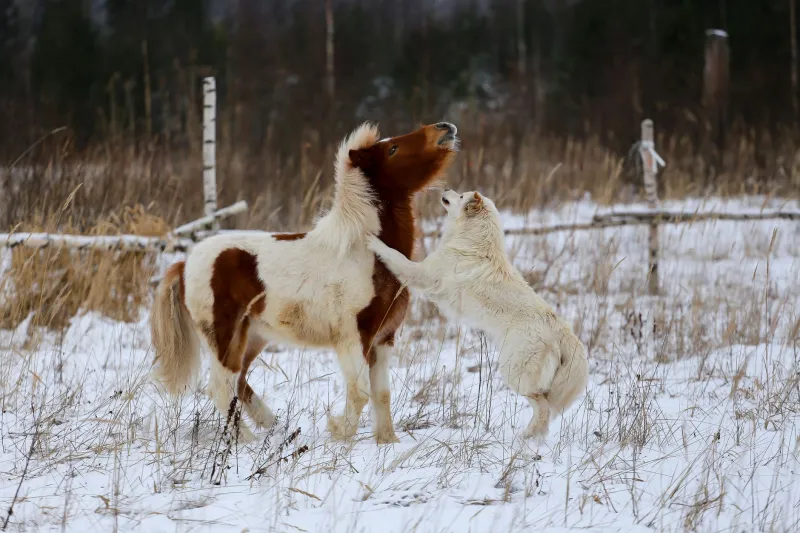
When you see a horse holding its tail naturally while a dog mills around nearby, and the dog is moving with a loose, low tail and relaxed posture, you're looking at two animals that have reached a comfortable understanding. That's the goal.
Posture and Proximity: The Dance of Confidence and Respect
How an animal holds its body — and how close it lets another animal get — reveals the underlying relationship dynamic in real time.
A horse that drops its head, softens its eye, and shifts its weight onto a relaxed hip while a dog is present is at ease. That same horse standing square, neck elevated, nostrils flared, and weight forward is braced for something. It's not necessarily going to blow up, but it's paying very close attention.
Dogs that are comfortable around horses often develop a kind of self-regulation that's genuinely impressive to watch. They learn not to dart behind the horse's hindquarters, not to bark suddenly from close range, and not to approach at a dead run. Dogs that haven't learned this yet are a real liability — not because they're bad dogs, but because they haven't yet decoded the horse's personal space rules.
If your dog consistently approaches your horse from the front and waits, rather than rushing in from the side or rear, that dog has figured something important out. Reward that behavior. It means they're reading the horse and responding appropriately.
Stress Signals You Don't Want to Miss
Early stress signals in both species are easy to overlook if you're not specifically looking for them. In horses, watch for: repeated yawning (not tiredness — often displacement behavior), tight muscles around the eye and jaw, excessive blinking, or a horse that keeps repositioning itself to keep the dog in its line of sight. That last one especially — a horse that can't relax its vigilance around a particular dog has not made peace with that animal's presence.
In dogs, stress around horses can show up as excessive lip licking, yawning, whale eye (showing the whites of the eyes), or a tucked tail combined with forward movement. A dog that desperately wants to investigate a horse but is also terrified is a dog that needs slow, managed introductions and a whole lot of patience.
Creating an Environment Where Both Animals Feel Heard
The practical takeaway from all of this is straightforward: the more you understand what your animals are communicating, the better you can arrange their environment to support positive interactions.
Give horses a space where they can move away from dogs if they choose — forced proximity is a recipe for tension. Make sure your dog has an exit route too; a cornered dog near a horse is a dangerous combination. Use feeding time strategically — animals that associate each other's presence with something good (like grain or a treat) build positive associations faster.
And honestly? Just watch them more. Put your phone down for ten minutes at the paddock. You'll be surprised how much is happening in a language that has nothing to do with sound.