From the Ground Up: What Hoof Care Taught Me About Keeping My Dog Sound
Spend enough time around horses and you start to develop a sixth sense about movement. You notice the subtle hitch in a trot, the way a horse shifts its weight loading a trailer, the slight flare on a hoof wall that wasn't there six weeks ago. That kind of ground-level awareness is practically a superpower — and if you own dogs too, it turns out you've been sitting on a goldmine of preventative health knowledge you might not even know you have.
The connection between equine hoof care and canine limb health isn't obvious at first glance. One animal walks on four hooves with no visible toes. The other prances around on padded paws with nails you probably trim once a month (or, let's be honest, whenever you remember). But underneath those surface differences, both animals share a fundamental biomechanical truth: everything starts at the ground.
Why Farriers Think Like Engineers
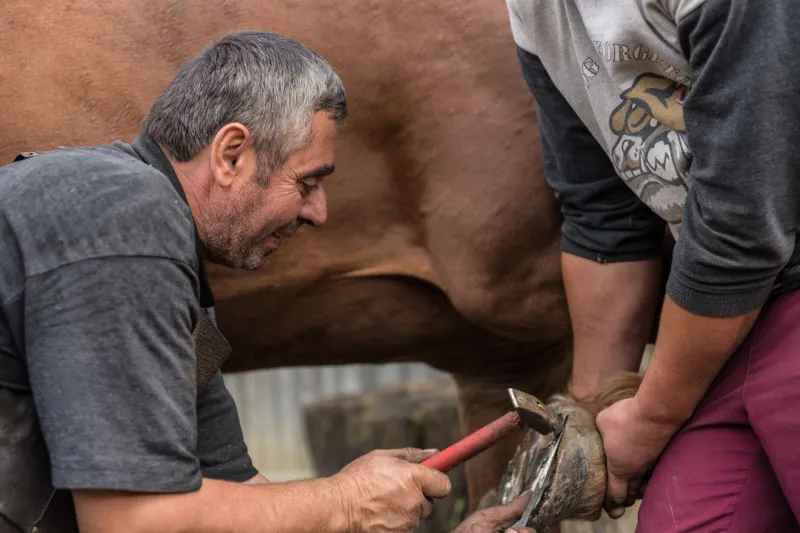
A good farrier doesn't just nail shoes onto a horse. They're reading the whole animal — assessing angles, evaluating breakover point, checking for uneven wear that signals something is off further up the leg. Medial-lateral imbalance in a hoof, for example, doesn't just stress the hoof itself. Over time it torques the fetlock, strains the suspensory ligament, and can work its way up to the knee and hock. What starts as a subtle lean in a shoe can end in a career-ending injury.
That chain reaction — from foot to joint to full-body compensation — works exactly the same way in dogs.
Canine orthopedic specialists have increasingly adopted gait analysis tools and pressure-mapping technology borrowed directly from the equine world. When a dog chronically favors one paw, the opposite shoulder absorbs the extra load. When rear leg weakness develops, the front end compensates. It's the same cascade farriers have been managing in horses for centuries, just scaled down and covered in fur.
The Nail Length Problem Nobody Talks About
Here's a direct parallel that most dog owners completely miss: long nails in dogs are the functional equivalent of a broken-back hoof angle in a horse.
When a horse's toe grows too long without trimming, the hoof-pastern axis breaks backward, putting strain on the deep digital flexor tendon. The horse's weight is no longer loading cleanly through the leg — it's fighting geometry every single step.
When a dog's nails are too long, they make contact with the ground before the pad does. That forces the dog's toes to splay and the paw to flatten, which rotates the pastern and shifts load onto the carpal and tarsal joints. Over months and years, that misalignment contributes to early arthritis, especially in larger breeds already predisposed to joint issues.
Your farrier would never let six weeks of growth go unchecked on your horse. Apply that same urgency to your dog's nail trims — every three to four weeks for most active dogs, more frequently for dogs that don't wear their nails down naturally on hard surfaces.
Reading the Wear Patterns
One of the first things a farrier checks is how a shoe or hoof is wearing. Uneven wear tells a story — a horse dragging its toe might have neurological issues, hock soreness, or poor shoeing. A horse wearing laterally might have conformational challenges or a footing problem in its turnout area.
You can do the same diagnostic work with your dog — you just have to know where to look.
Check your dog's nails after a few weeks of growth. Are they wearing evenly across all four feet? Is one paw's nails consistently longer than the others, suggesting the dog is offloading that leg? Look at the pads themselves. Callusing on one side of a pad, or asymmetrical wear on the outer edge, is the canine equivalent of a laterally worn shoe.
If you walk your dog on pavement regularly, the wear on their nails and pads is essentially a gait analysis report you can read for free. Most people just never think to look.
Weight Distribution and the Joint Tax
Horse owners who've dealt with laminitis understand viscerally how body weight and hoof health interact. An overweight horse places excess load on compromised hooves, accelerating rotation and inflammation. Managing body condition score isn't just about aesthetics — it's hoof health strategy.
The same math applies to dogs, and the numbers are arguably more dramatic. Studies from the Association for Pet Obesity Prevention consistently show that more than half of US dogs are overweight or obese. Every extra pound a dog carries adds roughly four to five pounds of force on its joints during normal movement. For a Labrador carrying fifteen excess pounds — a common scenario — that's sixty to seventy-five additional pounds of joint stress with every step.
If you've ever watched a farrier make the case to a horse owner that trimming cycles and body condition are directly linked to soundness, you already have the vocabulary to understand why your vet keeps bringing up your dog's weight at annual checkups. It's the same conversation, same stakes.
Early Intervention: The Lesson Both Species Teach
Perhaps the most valuable thing horse ownership teaches you is the cost of waiting. A hoof abscess caught early is a poultice and a few days of stall rest. Ignored, it can blow out through the coronary band and mean weeks of recovery. A mild case of thrush addressed promptly is a bottle of treatment and better turnout management. Left alone, it erodes the frog and creates chronic sensitivity that takes months to resolve.
Vet bills follow the same curve in dogs. A dog limping slightly after a run might have a minor soft tissue strain — rest, anti-inflammatories, and a week of easy walks. That same dog, pushed through the discomfort for another month because "he seems mostly fine," might end up with a partial cruciate tear that means surgery, rehabilitation, and a recovery measured in months and thousands of dollars.
The instinct you've developed to call your farrier when something looks even slightly off? That's the exact instinct to apply when your dog starts bunny-hopping up stairs, holding a paw slightly elevated during rest, or shifting its stance at the water bowl.
Building a Ground-Up Health Routine for Your Dog
If you manage your horse's hoof health proactively, here's how to bring that same structure to your dog:
- Establish a nail trim schedule and stick to it the way you stick to your six-week farrier appointments.
- Check paws weekly — look for pad cracking, foreign objects, nail splitting, or asymmetrical wear.
- Watch your dog move on different surfaces. Concrete, grass, and gravel all reveal different things about how an animal is loading its limbs.
- Photograph your dog's stance from the front and rear every few months. Subtle postural shifts are much easier to catch when you're comparing against a baseline.
- Keep body condition in check. Work with your vet to establish a target weight and monitor it the same way you'd monitor your horse's topline and rib coverage.
- Don't walk past a limp. One off day is a data point. Two off days in a row is a phone call to your vet.
The Compound Interest of Preventative Care
Horse people get it. You don't skip farrier visits because you understand that a small investment every six weeks prevents catastrophic expenses later. That mindset — that soundness is built incrementally, from the ground up, through consistent attention — is one of the most transferable skills in multi-species animal ownership.
Your dog is lucky to have someone in its corner who already thinks this way. All you have to do is look down.